
The Simple Money Playbook for Crypto Cycles: How to Survive the Crash and Profit from the Boom

Crypto Cycle Key Points

  • Cycles Are Fast: Crypto cycles are very quick (from 1 to 4 years max). Snooze, you lose.
  • Only 4 Phases Matter: Every time, the crypto market moves from the Quiet Buy (Accumulation) to the Big Rush (Markup), the Uncertainty Trap (Distribution), and the Big Crash (Markdown).
  • Profit Rule #1: In the Big Rush, you must sell portions into strength. Take your cash out after big jumps; don’t wait for the top.
  • Survival Rule #1: In the Big Crash, you only survive by Dollar-Cost Averaging (DCA). Buy slowly and only when prices are deeply discounted.
  • Stop Trading on Vibes: Use actual data. Watch for the Halving, on-chain whale selling, and the Fear-Greed Index.

The 5 W’s: A Crypto Cycle Overview

What is it? The predictable, repeating pattern of massive booms and brutal busts that controls the crypto market.

Why does it happen? It’s driven by the Bitcoin Halving (cutting supply), huge amounts of easy money (liquidity), and mass investor emotion (FOMO vs. Fear).

When does it happen? The full cycle completes over a compressed 1 to 4 years, making the moves fast and violent.

Who profits? “Smart money” (professionals) who buy when everyone is scared. “Retail investors” (the average crowd) usually jump in late and get wiped out.

Where are we now? The market is always moving. Check the signs: If your friends are excited, you are likely in the Big Rush or Uncertainty Trap phase.
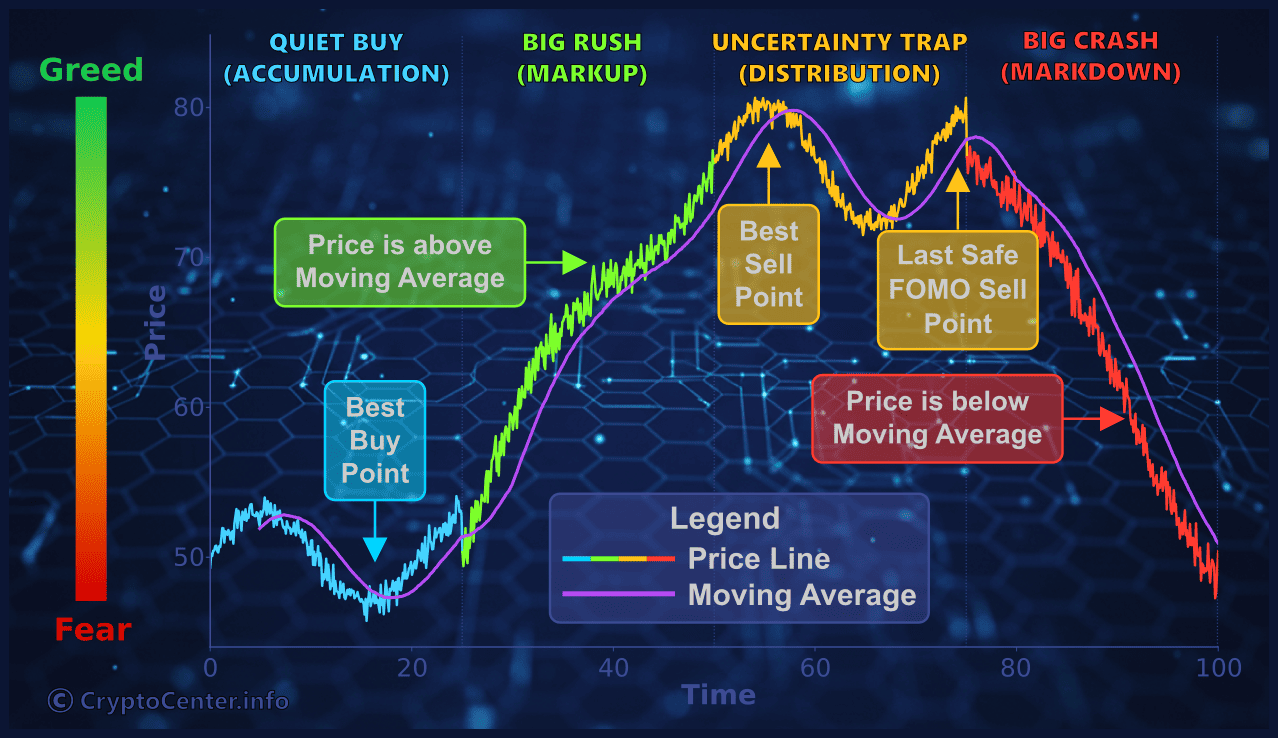
A simplified crypto market cycle chart showing four phases: The Quiet Buy (Accumulation), Big Rush (Markup), Uncertainty Trap (Distribution), and Big Crash (Markdown). The chart illustrates a price line crossing a moving average to identify the 'Best Time to Buy' and the 'Best Sell Point' for maximizing crypto profits.
Crypto Cycle Map: Timing Your Buy and Sell Points

Crypto Cycles Are Compressed

Crypto market cycles complete in just 1 to 4 years—much faster and steeper than traditional stocks.

The Smart Money Quiet Buy Zone

Prices are low and volume is light in the Accumulation phase, signaling quiet entry for experienced investors.
$ B B B

The Smart Money Big Rush Sell Zone

Experienced investors slowly sell while prices climb during the Markup Phase.
$ $ B

The Investor Uncertainty Trap

The distribution phase is when experienced investors capitalize on sales to late FOMO investors.
$

The Big Crash

the markdown phase is when experienced investors quietly sit on the sideline watching everybody panic sell as prices plunge.

You watch the news, and one week Bitcoin is crushing it. The next week, it’s a disaster. That feeling is the Crypto Cycle, and knowing how and why it unfolds is the only thing that matters.

If you don’t know where we are in that cycle, you’re gambling. If you do know, it’s a money-making machine.

This guide tells you exactly how to tell what phase the market is in, and what you need to be doing to buy low, sell high, and keep your cash.

The 4 Stages of the Money Cycle

The market always goes through the same four stages—they are relatively simple, somewhat predictable, and always repeat every cycle. Your job is to know which stage we’re in so you can take the right action. (This cycle is a common model in financial analysis, applied to crypto by major institutions like Investopedia and Ledger Academy.) (Source: Investopedia)

  1. The Quiet Buy (Accumulation)

    What it looks like: Prices are cheap. Everyone is depressed. The news is full of stories about people who lost money. Nobody is talking about crypto at work.

    The Smart Money Move: This is when the big, serious players quietly start buying. They are stacking up coins for pennies while the average person is too scared to look. (Source: Investopedia)

    Your Job: Buy slowly. This is your best chance to make money with crypto. Split your money into chunks and buy every few weeks. You are buying other people’s fear.

  2. The Big Rush (Bull Market / Markup)

    What it looks like: Prices are going wild. You see coins double, then triple. Your friends start asking you how to buy Bitcoin.

    The Smart Money Move: Smart money is already in from the Quiet Buy phase. When the public “Fear of Missing Out” (FOMO) kicks in and prices start soaring, this is the time for smart money to start their methodical exit strategy by selling small portions while the price is increasing.

    What Drives It: This stage is triggered by a combination of factors, primarily:

    • The Bitcoin Halving: (Cutting new supply)
    • New Cash: Huge waves of institutional or “easy money” flowing into the market.
    • Mass Emotion: Widespread public excitement (FOMO).

    Your Job: Stop being greedy and start selling portions. This is the time to start taking your original cash out of the game and locking in some profit.(More on this below).

  3. The Uncertainty Trap (Distribution)

    What it looks like: The price swings wildly up and down near the high. You have huge green days followed by scary red days. It feels completely confusing, leading investors to second-guess themselves.

    The Smart Money Move: They are almost done selling. They are selling the last of their coins to the people who are jumping in late. They create enough final excitement (or “upthrusts”) to sucker in the last few buyers before the crash.

    Your Job: Sell more portions! The market is warning you the party is ending. Do not buy anything new. Get your cash out.

  4. The Big Crash (Bear Market / Markdown)

    What it looks like: Prices drop 50%… 60%… maybe 80%. Everything feels hopeless. The historical reality is that major market crashes have resulted in drops of 70% to over 80% from the prior peak.

    The Smart Money Move: They are chilling on the sidelines with their piles of cash. They wait for the market to drop so low that people start panicking and selling coins for almost nothing.

    Your Job: Just wait. If you still have coins, don’t sell in a panic; go into HODL mode. Get your next buying plan ready. This phase resets the whole game for the next boom.

The Money-Making Rules: What to Do Right Now

The Bull Market Playbook (When Prices Are Flying)

Goal: Take Cash Out and Lock In Profit.

  1. The ‘Get Something Back’ Rule of Thumb (The Psychological Edge)
    : This rule is for reducing your risk exposure and creating the peace of mind necessary to hold the rest. By taking a small slice of money out, you ensure that if the market suddenly crashes, you won’t lose it all. This provides the psychological resolve to stick with your remaining, higher-risk coins.
    Calculate your average purchase price
    (the total amount you spent on a coin divided by the total coins you own). When the price of the coin climbs 30% or more above your average purchase price, you should sell 10-20% of your total holding of that specific coin. Put that money straight into your bank account.
  2. Get Your Original Cash Back (The True De-Risking Step)
    .
    The second your coin doubles (100% gain), sell enough to get your initial investment back.

    From this point onwards, the rest of your coins are running on “house money.” You are now in profit and cannot lose your initial capital.

  3. The Profit Maximizer (Systematic Selling)
    : This is the rule for ensuring you make a profit on the remaining high-risk coins. After securing your initial investment (Rule 2), you must sell gradually into the rising market to realize profit before the peak.
    Continue selling smaller portions (e.g., 5-10%) at set price intervals or timeframes throughout the Big Rush (Markup) phase.

    The goal is to sell the majority of the remaining coins before the Uncertainty Trap.

  4. Final Warning: Do Not Fall for Paper Wealth. The single biggest mistake is being a millionaire on paper but failing to execute your sell plan. Stick to your rules (Points 1, 2 and 3), and secure your cash.
    If you haven’t sold any crypto coins, you haven’t made any money.

The Bear Market Playbook (When Prices Are Dropping)

Goal: Stack Coins Cheaply.

  1. Wait for the real panic
    . Stop and look around. You want to buy when everyone else is miserable and the news is toxic. That’s the mood of a bottom.
  2. Use Your Simple Tool
    : The Average Line. On your charts, you’ll see a line called the “Moving Average.” Think of it as the coin’s long-term average cost. It filters out the daily noise and provides the most reliable signal.
    Your Buy Rule: Only add new cash when the price has been consistently below that average line for some time (it could be weeks or even months) and shows signs of flat, sideways trading (i.e., the price has stopped crashing). This consistency is your signal that the panic is over and coins are settling at their cheapest.
  3. Know the risk
    . The average crash for smaller coins is 70% to 80% from the high. Even Bitcoin typically drops into this severe range. Use a 50% drop as a signal that things are finally getting cheap enough to start watching that Average Line. (Source: NYDIG)
  4. Buy slowly, using portions
    . Use Dollar Cost Averaging (DCA) to purchase new coins. If you have $1,000, split it up and buy a small amounts, slowly over time. This averages out the highs and lows, and also prevents you from running out of cash before the price hits rock bottom.
  5. Hold the good stuff (And the Winners)
    . Focus most of your money on Bitcoin (BTC) and Ethereum (ETH). They always bounce back.
    For your “extra bet” money, look at the Top 10 to 20 coins that survived the last major 70%+ crash. If they crashed hard and came back strong once, they are your best bet to repeat it.

The One Rule You Can’t Break

NEVER invest money you need to pay bills or rent.

Treat crypto like a small casino fund. If you lose all of it, your life can’t change. If you win big, great. This one rule keeps you calm and stops you from panic-selling when the crash comes.

Frequently Asked Questions

Is the Crypto Cycle always 4 years?

No. The cycle is based on the Bitcoin Halving (every 4 years), but the length of the bull and bear phases can vary. While the overall pattern repeats, the timing has sped up as the market matures.

What is the “Moving Average” in the chart?

The Moving Average is simply a technical line on the chart that shows the average price over a long period (like 200 days). It helps cut out daily noise and is your most reliable signal for identifying cheap prices.

Should I sell all my Bitcoin in the Uncertainty Trap (Distribution) phase?

The Uncertainty Trap is the final warning. You should have already sold the vast majority of your coins before this phase even began.

If you have followed the playbook correctly:

  1. You have significantly reduced your exposure by selling a small portion (Rule 1), guaranteeing that you won’t lose it all if the market crashes immediately.

  2. You have successfully recovered all of your initial investment (Rule 2).

  3. The remaining high-risk coins should have been sold off methodically throughout the Big Rush (Markup) phase.

The Uncertainty Trap is a period of extreme market volatility that naturally occurs near the peak. Smart money exploits this phase by using the large price swings to offload their final holdings to late retail buyers.

Action: If you still have any coins left at this stage, aggressively liquidate them all immediately. Finish your sell plan completely. Do not let paper wealth or final volatility trick you into holding coins into the Big Crash.

What drives the crypto market cycles?

The primary driver is the Bitcoin Halving, which occurs roughly every four years and instantly cuts the supply of new Bitcoin. This scarcity, combined with global liquidity (easy money from central banks) and mass investor psychology (FOMO and Fear), creates the violent boom-and-bust cycle.

How do I know when the “Big Crash” (Markdown) phase is over?

The Big Crash phase is typically over when two things happen:
  1. Time: The bear market lasts at least 9 to 12 months.
  2. Price: The price has dropped below its Moving Average line and has stopped falling, showing an extended period of sideways trading (the Quiet Buy (Accumulation) phase).
When To Sell During a Bull Run?
The mistake most investors make is trying to guess the single highest point. You should never try to guess the top. The correct approach is to use a systematic plan to sell portions methodically as the price climbs.

Your playbook provides three clear rules for selling during a bull run:

  1. The ‘Get Something Back’ Rule (The Psychological Edge)

    You sell the first portion of your coins (10-20%) when the price is 30% above your average purchase price. The purpose of this step is to reduce your initial risk exposure, guaranteeing that you have a slice of capital protected if the market crashes. This provides the psychological resolve to hold the remaining, higher-risk coins.

  2. Get Your Original Cash Back (The De-Risking Step)

    The moment your investment doubles (a 100% gain), sell just enough to recover all of the money you initially invested. At this point, the rest of your coins are running on “house money,” meaning you have secured your principal and cannot lose your initial capital.

  3. Systematic Final Exit

    After securing your cash, you continue to sell smaller portions (e.g., 5-10%) at set price intervals or timeframes throughout the Big Rush (Markup) phase. By the time the market enters the dangerous Uncertainty Trap (Distribution) phase, your entire sell plan should be complete, leaving you with cash safely in the bank.

References & Further Reading

The Market Cycle Model

This four-phase model is a standard concept in financial analysis, applied to crypto market behavior. Read more on the four phases of market cycles (Investopedia)

The Bitcoin Halving

The halving event, which reduces new coin supply, has historically preceded the major bull runs, creating the cyclical nature of the market. Read about the Bitcoin Halving and its market impact (Investopedia)

Historical Crash Data

Major drawdowns (drops) of 70% or more are a recurring feature of Bitcoin’s history after major cycle peaks. See historical Bitcoin drawdowns (NYDIG)

Foundational Theory and Proof

The Market Cycle Model (Wyckoff)

This four-phase model is the foundation of modern technical analysis, showing how institutional “smart money” systematically buys from panicked sellers and sells to FOMO buyers. Read more on the Wyckoff Market Cycle and its four phases (Investopedia)

The Halving as the Cycle Trigger

Academic research confirms that the programmed supply shock from the Halving is a primary driver, correlating strongly with the start of a new bull cycle 12–18 months later. Review Bitcoin Scarcity Models and Time Series Analysis (MDPI)

Loss Aversion (Prospect Theory)

The ‘Get Something Back’ Rule is a direct countermeasure to the behavioral bias of Loss Aversion, giving you the psychological resolve to hold your remaining coins. Review Prospect Theory: An Analysis of Decision under Risk (Kahneman & Tversky, 1979)

Strategic Dollar-Cost Averaging

This combines the classic risk-mitigation strategy of DCA with technical analysis, only adding new capital when the price is consistently below the long-term average (like the 200-day MA). Learn more about Dollar-Cost Averaging as a risk-mitigation strategy (Investopedia)

Pajamas Cat (PAJAMAS) Cryptocurrency Market Data and Information

What is Pajamas Cat (PAJAMAS)?

Pajamas Cat (PAJAMAS) is a cryptocurrency inspired by the iconic first cat video uploaded to YouTube. This video, featuring YouTube co-founder Steve Chen’s pet cat named “Pajamas,” has historical significance in the world of online video. PAJAMAS aims to capture this cultural moment within the digital asset space.

As a meme coin, Pajamas Cat leverages internet culture and virality to gain traction. Unlike many cryptocurrencies with complex technical foundations, PAJAMAS is driven primarily by community engagement and online trends.

The project’s core idea is to pay homage to the foundational elements of internet culture. It uses the nostalgia and recognition associated with the first cat video on YouTube to attract interest and build a community around the coin.

How Does Pajamas Cat (PAJAMAS) Work?

Pajamas Cat operates as a cryptocurrency typically built on an existing blockchain network, such as Ethereum or Binance Smart Chain. This means it leverages the infrastructure and security of that underlying blockchain. Transactions are recorded on the blockchain, providing transparency and immutability.

The coin’s functionality often revolves around smart contracts that govern its distribution, trading, and any additional features. These contracts ensure that the rules of the cryptocurrency are enforced programmatically.

Like other cryptocurrencies, PAJAMAS relies on community involvement to drive its value and popularity. Active participation in social media, online forums, and community events is crucial for its growth.

Pajamas Cat (PAJAMAS) Key Features and Technology

Pajamas Cat often emphasizes simplicity and community focus over complex technological innovations. Key features often revolve around tokenomics designed to incentivize holding and trading the coin.

Depending on the implementation, features such as deflationary mechanisms, reflection rewards (where holders receive a portion of transaction fees), or staking opportunities might be present. These mechanics encourage users to maintain their holdings.

The community is a crucial element of the coin. The development team typically concentrates on fostering an active and engaged community through social media and other channels.

What is Pajamas Cat (PAJAMAS) Used For?

As a meme coin, the primary use case for Pajamas Cat is often speculative trading and community engagement. Its value is primarily driven by sentiment and popularity within the cryptocurrency community.

It can be used for tipping and rewarding community members for their contributions, fostering a sense of belonging and shared purpose. PAJAMAS may also be integrated into online games, social media platforms, or other digital content.

While not typically designed for practical applications such as payments or decentralized finance (DeFi), PAJAMAS can serve as a gateway for individuals to learn about and participate in the broader cryptocurrency ecosystem.

How Do You Buy Pajamas Cat (PAJAMAS)?

Buying Pajamas Cat involves a process similar to acquiring other cryptocurrencies. The first step is to find an exchange that lists the coin. Centralized exchanges (CEXs) or decentralized exchanges (DEXs) may offer PAJAMAS.

Once you have identified an exchange, you will need to create an account and complete any necessary verification steps, such as KYC (Know Your Customer) procedures. Funding your account usually requires transferring cryptocurrency, such as ETH or BNB, to the exchange.

Once your account is funded, you can navigate to the trading pair for PAJAMAS and place an order to buy the coin. Popular exchanges that might list PAJAMAS include:

  • Uniswap (a popular DEX on Ethereum)
  • PancakeSwap (a popular DEX on Binance Smart Chain)
  • MEXC (a CEX which often lists meme coins)

How Do You Store Pajamas Cat (PAJAMAS)?

Storing Pajamas Cat securely is essential to protect your investment. Since it’s often an ERC-20 or BEP-20 token, it can be stored in wallets compatible with those standards.

Software wallets (also known as hot wallets) are applications you can install on your computer or mobile device. These are convenient for frequent trading but less secure than hardware wallets. Examples of software wallets include:

  • MetaMask (browser extension and mobile app)
  • Trust Wallet (mobile app)

Hardware wallets (also known as cold wallets) are physical devices that store your private keys offline. These provide the highest level of security. Examples of hardware wallets include:

  • Ledger Nano S/X
  • Trezor Model T

Future Outlook and Analysis for Pajamas Cat (PAJAMAS)

The future of Pajamas Cat, like many meme coins, is heavily reliant on community support and continued online interest. The coin’s success hinges on its ability to maintain relevance and attract new participants.

Broader trends in the cryptocurrency market, such as increased adoption or regulatory changes, can also impact the performance of PAJAMAS. These external factors can significantly influence investor sentiment and trading volume.

Potential developments could include new partnerships, integrations with other platforms, or the introduction of innovative features. The Pajamas Cat community will have to adapt to the ever changing crypto and internet space.

References

CoinGecko

CoinDesk

ETF The Token (ETF) Cryptocurrency Market Data and Information

What is ETF The Token (ETF)?

ETF The Token (ETF) aims to bridge the memetic appeal of cryptocurrency with the significant catalyst of spot Bitcoin ETF applications and the associated decisions made by the U.S. Securities and Exchange Commission (SEC). The token launched on September 1, 2023, on the Uniswap decentralized exchange. ETF The Token leverages the ongoing narrative surrounding spot Bitcoin ETFs, providing a platform to gamify the application process and foster a community of crypto enthusiasts who share a common interest in this area.

The project distinguishes itself by focusing on the specific spot Bitcoin ETF narrative. This focus allows for the creation of engaging games and community activities centered around the anticipation and outcomes of the ETF application process. By gamifying SEC decisions related to spot ETF applications, ETF The Token keeps users involved and informed about the market’s status.

Essentially, ETF The Token aims to be more than just a meme coin. It attempts to combine meme culture with the real-world events and decisions influencing the crypto market, specifically those concerning spot Bitcoin ETFs. The project intends to create a unique and dynamic ecosystem centered around the ETF narrative.

How Does ETF The Token (ETF) Work?

ETF The Token operates on the Ethereum blockchain as an ERC-20 token. This means it adheres to a standard set of rules and protocols that govern how tokens function within the Ethereum ecosystem. Because it is on the Ethereum network, it benefits from the security, decentralization, and smart contract capabilities offered by Ethereum.

The token’s functionality is closely tied to the SEC’s decisions regarding spot Bitcoin ETF applications. The project leverages these decisions to create gamified experiences and reward token holders. The specifics of these gamified experiences are detailed on the etf.live website, according to the project’s documentation.

In essence, ETF The Token’s value and utility are inherently linked to the real-world events surrounding spot Bitcoin ETFs. The community is incentivized to stay informed and engaged with these developments through the project’s gamified system. The hope is that as the crypto ETF market develops, the ETF The Token will provide users with insight into a developing market.

ETF The Token (ETF) Key Features and Technology

The main technology behind ETF The Token is its foundation as an ERC-20 token on the Ethereum blockchain. This is essential for the token’s functionality. ERC-20 tokens are compatible with a wide range of wallets, exchanges, and decentralized applications (dApps) within the Ethereum ecosystem.

The key feature of ETF The Token is its gamification of the spot Bitcoin ETF application process. This unique application is designed to engage the community and to create a dynamic and involved ecosystem. This includes real-time market developments.

  • ERC-20 Standard: Ensures compatibility and interoperability within the Ethereum ecosystem.
  • Gamified Experience: Makes tracking ETF decisions more engaging and interactive.
  • Community Focus: Aims to build a community of crypto enthusiasts interested in ETF developments.

What is ETF The Token (ETF) Used For?

Currently, ETF The Token can be used for trading on decentralized exchanges like Uniswap. As an ERC-20 token, it can be transferred, stored, and used in various Ethereum-compatible wallets and applications. However, its primary intended use is participation in the project’s gamified experiences related to Bitcoin ETF decisions.

The project aims to provide users with a means of engaging with the spot Bitcoin ETF narrative. ETF The Token wants users to follow ETF news and developments closely. By holding and using ETF The Token, users can potentially benefit from their knowledge and predictions related to the ETF approval process.

In summary, while ETF The Token functions as a standard ERC-20 token, its intended purpose is to serve as a key to its project’s ecosystem. This means the token provides access to unique interactions related to spot Bitcoin ETFs. The value and utility of the token are intertwined with the success and engagement within this ecosystem.

How Do You Buy ETF The Token (ETF)?

ETF The Token is primarily available on decentralized exchanges (DEXs) such as Uniswap. Buying ETF The Token involves a few key steps that are typical for purchasing ERC-20 tokens on DEXs. First, you will need to acquire a cryptocurrency like Ether (ETH) to make your transaction.

After getting ETH, you need to connect a Web3 wallet (like MetaMask, Trust Wallet, or Coinbase Wallet) to the DEX. These wallets allow you to interact with decentralized applications directly from your browser or mobile device. Once your wallet is connected, you can swap ETH for ETF The Token.

Here’s a general outline of the process:

  • Acquire ETH: Purchase Ether (ETH) from a centralized exchange like Coinbase or Binance.
  • Install a Web3 Wallet: Download and set up a wallet like MetaMask or Trust Wallet.
  • Transfer ETH: Send your ETH from the exchange to your Web3 wallet.
  • Connect to Uniswap: Go to Uniswap and connect your wallet.
  • Swap ETH for ETF: Select ETF The Token and specify the amount of ETH you want to swap.
  • Confirm the Transaction: Approve the transaction in your wallet and pay the gas fees.

Always double-check the contract address of ETF The Token to ensure you are trading the correct token.

How Do You Store ETF The Token (ETF)?

Because ETF The Token is an ERC-20 token, it can be stored in any Ethereum-compatible wallet. These wallets come in various forms, each with its own set of security features and convenience factors. The choice of wallet depends on individual needs and risk tolerance.

Software Wallets (Hot Wallets): These wallets are applications that can be installed on your computer or smartphone. Popular options include MetaMask, Trust Wallet, and Coinbase Wallet. Software wallets are convenient for frequent trading and transactions, but they are generally considered less secure than hardware wallets.

Hardware Wallets (Cold Wallets): These are physical devices that store your private keys offline, providing an extra layer of security. Ledger and Trezor are popular hardware wallet brands. Hardware wallets are ideal for long-term storage of larger amounts of ETF The Token.

  • MetaMask: A browser extension and mobile app wallet.
  • Trust Wallet: A mobile-only wallet with a built-in DApp browser.
  • Coinbase Wallet: A user-friendly wallet offered by Coinbase.
  • Ledger: A hardware wallet for secure offline storage.
  • Trezor: Another popular hardware wallet with similar features to Ledger.

Future Outlook and Analysis for ETF The Token (ETF)

The future outlook for ETF The Token is closely tied to the developments surrounding spot Bitcoin ETFs. The success of the token relies heavily on its ability to maintain community engagement and its continued relevance to the ETF narrative. As the SEC makes decisions, the gamified experiences will need to be engaging and updated.

One of the key challenges for ETF The Token is maintaining long-term utility and relevance. Meme coins often experience rapid surges in popularity followed by periods of decline. The project will need to innovate and expand its offerings to retain users and attract new participants.

Overall, ETF The Token’s future depends on its ability to deliver engaging content, maintain a strong community, and adapt to the evolving landscape of Bitcoin ETFs. If the project can successfully navigate these challenges, it has the potential to carve out a unique niche within the cryptocurrency space. However, investors should exercise caution and conduct thorough research before investing in ETF The Token, as with any cryptocurrency.

References

LEEROY JENKINS (LEEROY) Cryptocurrency Market Data and Information

What is LEEROY JENKINS (LEEROY)?

LEEROY JENKINS (LEEROY) is a meme token operating on the ERC-20 blockchain. It is built around the famous internet meme and video game reference. The project emphasizes community engagement and aims to leverage its namesake’s popularity to create a vibrant ecosystem.

Meme tokens are often driven by social media trends and community sentiment. LEEROY is no exception, relying heavily on its association with the iconic “Leeroy Jenkins” moment to attract users and build its brand. The token’s success depends on maintaining community interest and fostering active participation.

As an ERC-20 token, LEEROY benefits from the security and infrastructure of the Ethereum network. This allows for seamless integration with various decentralized applications (dApps) and wallets within the Ethereum ecosystem.

How Does LEEROY JENKINS (LEEROY) Work?

LEEROY, like other ERC-20 tokens, operates on the Ethereum blockchain. Transactions involving LEEROY are recorded on this decentralized ledger, ensuring transparency and immutability. This means that every transfer and interaction involving the token is publicly verifiable.

The underlying mechanisms of LEEROY involve smart contracts deployed on the Ethereum network. These smart contracts define the token’s rules, including its supply, transfer mechanisms, and any other specific functionalities. These contracts are self-executing, meaning they automatically enforce the agreed-upon conditions.

Community-driven initiatives and marketing efforts play a crucial role in the token’s functionality. The value and adoption of LEEROY depend on the community’s ability to create engaging content, promote the token, and foster a sense of belonging among its users.

LEEROY JENKINS (LEEROY) Key Features and Technology

Being an ERC-20 token, LEEROY inherits the technical advantages of the Ethereum blockchain. This includes security, decentralization, and interoperability with other ERC-20 tokens and Ethereum-based applications. Ethereum’s robust network provides a solid foundation for LEEROY’s operations.

The key feature of LEEROY lies in its branding and association with the “Leeroy Jenkins” meme. This recognizable name provides instant appeal and helps the token stand out in the crowded cryptocurrency market. The use of humor can be a powerful tool for attracting attention and building a community.

The active community is also a crucial aspect of LEEROY. The token’s success is intimately tied to the community’s ability to generate buzz, create content, and promote adoption. Community-driven initiatives can range from online contests to charitable donations, all designed to engage users and increase the token’s visibility.

What is LEEROY JENKINS (LEEROY) Used For?

LEEROY is primarily used as a medium of exchange within its community. It facilitates transactions, rewards participation, and supports various community-driven initiatives. It can be used for tipping, gifting, or purchasing community-related merchandise.

The token also serves as a tool for community engagement and governance. Holders of LEEROY may have voting rights in decisions related to the project’s development and direction. This gives community members a voice and a sense of ownership in the project’s future.

Furthermore, LEEROY can be used as a speculative asset. Like many cryptocurrencies, its value is subject to market fluctuations. Some users may choose to buy and hold LEEROY with the expectation of future appreciation.

How Do You Buy LEEROY JENKINS (LEEROY)?

Purchasing LEEROY involves several steps. First, you’ll need to acquire a cryptocurrency like Ethereum (ETH) or another cryptocurrency which can be swapped for LEEROY. This can be done on major cryptocurrency exchanges.

Next, you’ll need to use a decentralized exchange (DEX) that lists LEEROY. Popular DEXs include Uniswap or SushiSwap. These platforms allow you to swap your ETH or other cryptocurrencies for LEEROY directly from your wallet.

Finally, connect your crypto wallet (like MetaMask or Trust Wallet) to the DEX and execute the swap. Be sure to double-check the contract address of LEEROY to avoid purchasing a fake token. Due to the potential volatility and scam risk for meme coins, always conduct your own research and exercise caution.

How Do You Store LEEROY JENKINS (LEEROY)?

Since LEEROY is an ERC-20 token, it can be stored in any wallet that supports the Ethereum network. These wallets come in various forms, including software wallets, hardware wallets, and web wallets.

Software wallets are applications that you install on your computer or smartphone. Popular options include MetaMask, Trust Wallet, and MyEtherWallet. These wallets are convenient for everyday use but are generally considered less secure than hardware wallets.

Hardware wallets are physical devices that store your private keys offline. These are considered the most secure option for storing cryptocurrencies. Examples of hardware wallets include Ledger and Trezor. Web wallets are browser-based wallets that can be accessed from any device, but come with added security risks.

Future Outlook and Analysis for LEEROY JENKINS (LEEROY)

The future of LEEROY depends heavily on its ability to maintain community engagement and adapt to the evolving cryptocurrency landscape. As a meme token, it faces the challenge of sustaining interest beyond initial hype. The project’s success will hinge on its ability to create innovative use cases and foster a strong sense of community.

The overall market sentiment towards meme tokens will also play a significant role. If the broader market loses interest in meme tokens, LEEROY could face challenges in maintaining its value and relevance. Conversely, a resurgence in meme token popularity could provide a boost to the project.

Potential partnerships and integrations with other projects in the Ethereum ecosystem could also contribute to LEEROY’s future growth. Collaborations with other communities and projects could help expand its user base and increase its visibility. Overall, the future of LEEROY is uncertain and relies on community support and external market forces.

References

LANDWOLF (LANDWOLF) Cryptocurrency Market Data and Information

What is LANDWOLF (LANDWOLF)?

LANDWOLF (LANDWOLF) is a cryptocurrency operating within the meme coin landscape, drawing inspiration from internet culture. It positions itself as a member of the “Boys’ Club,” a collective of meme-based cryptocurrencies that includes Pepe, Andy, and Brett. LANDWOLF is portrayed as the fun-loving, sometimes eccentric, and hug-embracing character within this group. It aims to capture attention and build a community through relatable internet humor and a lighthearted brand identity.

The coin is built around a specific character and narrative, differentiating itself by focusing on a particular persona within the meme coin ecosystem. This approach hopes to cultivate a dedicated following driven by shared affinity for the character and the associated humor. The project seeks to leverage the viral potential of internet memes to achieve broader recognition and adoption.

LANDWOLF aims to establish a distinct identity within the crowded meme coin space by emphasizing its character-driven narrative. This narrative helps attract users and fosters community engagement. It promotes LANDWOLF as a coin with a playful and approachable personality. The cryptocurrency seeks to harness the power of internet culture to create a unique and memorable brand.

How Does LANDWOLF (LANDWOLF) Work?

The specific mechanisms underlying LANDWOLF’s operation depend on the blockchain it is built upon. As a meme coin, LANDWOLF likely utilizes an existing blockchain network like Ethereum or Binance Smart Chain. The coin functions using smart contracts, which automate specific tasks and rules. These smart contracts govern the buying, selling, and distribution of LANDWOLF tokens.

Transaction validation typically relies on the consensus mechanism of the host blockchain. This means that the underlying blockchain’s security and governance protocols are inherited by LANDWOLF. The decentralized nature of the host blockchain ensures transparency and immutability of LANDWOLF transactions. This approach helps to increase trust within the community.

LANDWOLF’s value is largely driven by community sentiment and market speculation. It works through the creation of an online community that helps to generate interest in the coin. The network effect can therefore significantly influence its price and adoption. The project likely employs various marketing strategies to cultivate this community and maintain momentum.

LANDWOLF (LANDWOLF) Key Features and Technology

LANDWOLF’s key features revolve around its meme-driven branding and community focus. The primary technology behind it involves the utilization of blockchain technology for transactions. It relies on smart contracts to automate and govern various aspects of the token’s functionality. Its key feature is to generate interest in its community and its market adoption.

LANDWOLF is built on existing blockchain infrastructure, inheriting the benefits of decentralization and security from that host blockchain. The decentralized ledger ensures that all transactions are transparent and verifiable. The immutability of the blockchain makes LANDWOLF transactions resistant to censorship or tampering. This allows for a transparent and verifiable transaction history.

The LANDWOLF project leverages social media and community-driven marketing to increase the token’s visibility. Community involvement and meme creation further promote engagement with the coin. The unique branding and narrative that surrounds the coin, help it to stand out in the crowded cryptocurrency market. This creates a viral effect as users share and spread the token’s branding.

What is LANDWOLF (LANDWOLF) Used For?

LANDWOLF, like many meme coins, primarily functions as a digital asset for speculation and community interaction. It serves as a medium of exchange within the LANDWOLF community for rewarding active members. It can be used to incentivize participation and engagement. Users can send LANDWOLF tokens as tips or rewards to fellow community members.

The LANDWOLF cryptocurrency aims to provide an engaging and entertaining experience for its holders. It provides its users the ability to participate in a lighthearted online community. It gives users the opportunity to engage in meme creation and social interaction. It can act as a way to build community and reward active participation.

It can also be used to participate in raffles and games that are part of the LANDWOLF ecosystem. Its main purpose is to generate interest in the ecosystem. This increases its trading volume and generates greater exposure for the project. The aim is to build a strong community around the LANDWOLF brand.

How Do You Buy LANDWOLF (LANDWOLF)?

Purchasing LANDWOLF typically involves using a cryptocurrency exchange that lists the token. Potential buyers first need to create an account on a centralized or decentralized exchange. Once an account is created, users must deposit funds into their exchange wallet, typically in the form of another cryptocurrency like ETH.

After depositing funds, users can then trade their existing cryptocurrency for LANDWOLF. This process usually involves placing a buy order for LANDWOLF with the desired amount and price. Once the order is filled, the LANDWOLF tokens will be credited to the user’s exchange wallet.

Popular exchanges that list LANDWOLF may vary, so it’s essential to check current listings on cryptocurrency tracking websites. Some popular exchanges could include Uniswap, PancakeSwap, or centralized exchanges such as MEXC. Conducting thorough research before using any exchange is always advisable, to ensure security and reliability. Always make sure to trade on a reputable exchange with good security practices.

How Do You Store LANDWOLF (LANDWOLF)?

Storing LANDWOLF securely requires a compatible cryptocurrency wallet. The specific type of wallet depends on individual preferences. Options range from hardware wallets for maximum security to software wallets for convenience. It is important to consider the security risks and benefits.

Hardware wallets, such as Ledger and Trezor, offer the highest level of security by storing private keys offline. Software wallets, like MetaMask and Trust Wallet, are convenient for everyday use but are more susceptible to online threats. Some software wallets are browser extensions, while others are mobile apps.

Regardless of the wallet type, keeping the private key or seed phrase secure is essential. This information grants access to the LANDWOLF tokens. Backing up the wallet and storing the backup in a secure location is also important. Choosing a reputable and well-reviewed wallet is crucial for the security of your assets.

Future Outlook and Analysis for LANDWOLF (LANDWOLF)

The future outlook for LANDWOLF is highly speculative, as with most meme coins. Its success hinges on sustained community interest and active marketing efforts. The ability to foster a strong and engaged community will be critical. It requires that the cryptocurrency be able to maintain awareness.

The cryptocurrency could also look into exploring new use cases and partnerships. It needs to be able to differentiate itself from the competition. It also needs to expand its appeal beyond the initial meme coin hype. Future development could include integrating LANDWOLF into games or other applications.

The long-term viability of LANDWOLF depends on its ability to transcend its meme origins. It needs to develop real-world applications and utility. This will build a sustainable ecosystem around the token. Investors should exercise caution and conduct thorough research before investing in LANDWOLF or any other meme coin.

References

Penguin Tariff (PT) Cryptocurrency Market Data and Information

What is Penguin Tariff (PT)?

Penguin Tariff (PT) is a meme cryptocurrency that emerged, drawing its thematic inspiration from satirical commentary on trade policies, specifically referencing former U.S. President Donald Trump’s tariffs. The token’s concept centers around a fictional island nation inhabited solely by penguins, highlighting the potential impact of trade regulations on even the most remote and seemingly unaffected communities. PT differentiates itself through its unique narrative and community-driven focus within the meme coin landscape.

PT aims to create a lighthearted and engaging entry point into the cryptocurrency world. It seeks to connect with individuals who appreciate humor and satire while also exploring the broader implications of global economic policies. The project leverages the power of memes to attract attention and foster a sense of community among holders.

The origins of PT are rooted in the online culture of meme creation and the increasing popularity of cryptocurrencies built around internet jokes and viral content. The team behind PT sought to capitalize on the existing interest in meme coins by creating a project with a distinct theme and a commitment to transparency. The initial steps included code audits and listings on centralized exchanges to legitimize the coin and improve its accessibility.

How Does Penguin Tariff (PT) Work?

Penguin Tariff (PT) operates like many other cryptocurrencies, utilizing a blockchain to record transactions and ensure security. The specific blockchain that PT operates on isn’t mentioned explicitly in provided text. Understanding which blockchain network powers the PT token (such as Ethereum, Binance Smart Chain, or others) is crucial for comprehending its mechanics.

The token ownership for PT was burned. This means that the team relinquished control over the smart contract, which instills confidence in the coin and can reduce the possibility of it being manipulated. In addition, all Liquidity Pool (LP) tokens were burned, meaning that the coin founders cannot pull liquidity from the exchange.

The decentralized nature of the blockchain means transactions are transparent and verifiable. The use of smart contracts facilitates the execution of various functions. This can include token distribution, governance mechanisms (if implemented), and any other rules or functionalities coded into the contract.

Penguin Tariff (PT) Key Features and Technology

A key feature of Penguin Tariff (PT) is its meme-driven identity, which aims to differentiate it from other cryptocurrencies. The satirical theme referencing Trump’s tariffs and penguins adds a unique layer of humor and topicality. This allows the project to connect with users who appreciate internet culture and social commentary.

The fact that the code was audited enhances security. This assures potential investors that the smart contract has been reviewed for vulnerabilities. Listing on multiple centralized exchanges is another important factor for PT, enabling broader access and increased liquidity.

The burning of both token ownership and LP tokens is a notable characteristic, that assures the community that the coin is decentralized and that the value is not able to be manipulated by the project founders. While specific technological advancements may not be explicitly highlighted, focusing on security and accessibility is a core strategy.

What is Penguin Tariff (PT) Used For?

The primary use case for Penguin Tariff (PT) lies within its community and the broader meme coin ecosystem. It is used as a medium for value transfer, speculative trading, and community engagement. Holders of PT can trade the token on supported exchanges and participate in online discussions surrounding the project.

The meme-driven nature of PT encourages social interaction and content creation. Users may create and share memes, artwork, and other content related to the penguin tariff theme. This creates a sense of community ownership and fosters engagement with the project.

PT seeks to offer an accessible and entertaining entry point into the world of cryptocurrency. By leveraging the power of memes, it strives to attract a wider audience beyond traditional investors. The success of PT depends on the continued engagement of its community and the broader interest in meme-based cryptocurrencies.

How Do You Buy Penguin Tariff (PT)?

Purchasing Penguin Tariff (PT) involves a few key steps, starting with finding a suitable exchange that lists the token. Typically, this involves creating an account on a centralized cryptocurrency exchange (CEX) that supports PT. This will require providing personal information and completing any necessary identity verification procedures.

Once the account is set up and verified, users can deposit funds, either in the form of fiat currency or other cryptocurrencies like Bitcoin (BTC) or Ethereum (ETH). These funds can then be used to purchase PT through the exchange’s trading interface. It is important to understand the different order types available (e.g., market orders, limit orders) and any associated trading fees.

According to available information, Penguin Tariff (PT) has been listed on exchanges such as LBank and MEXC. These platforms provide trading pairs that allow users to exchange other cryptocurrencies for PT. Check official exchange announcements or CoinGecko or CoinMarketCap to confirm currently supported exchanges.

How Do You Store Penguin Tariff (PT)?

Storing Penguin Tariff (PT) requires a compatible cryptocurrency wallet. The specific type of wallet needed will depend on the blockchain PT operates on. Since the chain is not stated in the text, the user will need to determine what chain is needed.

For tokens on the Ethereum blockchain, popular options include MetaMask, Trust Wallet, and Ledger (hardware wallet). For tokens on the Binance Smart Chain, Trust Wallet and Ledger are viable options. These wallets allow users to securely store their PT tokens, send and receive transactions, and interact with decentralized applications (dApps) built on the same blockchain.

When choosing a wallet, it’s important to consider factors such as security, user-friendliness, and compatibility with the relevant blockchain. Hardware wallets are generally considered the most secure option as they store private keys offline, protecting them from online threats. Software wallets offer convenience but require greater vigilance in protecting the device they are installed on.

Future Outlook and Analysis for Penguin Tariff (PT)

The future outlook for Penguin Tariff (PT) is closely tied to the ongoing popularity of meme coins and the ability of the project to maintain community engagement. Success depends on several factors, including continued social media presence and the coin’s ability to capitalize on relevant events related to global trade and politics. The meme coin market is highly volatile and driven by sentiment, requiring a solid strategy for continued growth.

The project’s reliance on a meme-based narrative introduces both opportunities and risks. The unique theme can attract attention and foster community, but it also makes the token susceptible to rapid shifts in online trends. The team behind PT must continuously innovate and adapt to remain relevant and maintain interest in the project.

Ultimately, the long-term viability of Penguin Tariff (PT) hinges on its ability to develop a clear value proposition beyond its meme-driven appeal. This may involve exploring partnerships, integrating with other blockchain projects, or developing innovative use cases for the token. Ongoing monitoring of the cryptocurrency market and proactive adaptation to changing trends are essential for the project’s future success.

References

Just a based guy (BASEDGUY) Cryptocurrency Market Data and Information

What is Just a Based Guy (BASEDGUY)?

Just a Based Guy (BASEDGUY) is a meme coin project built on the Base blockchain, an Ethereum Layer 2 scaling solution. Inspired by the popular “Just a Chill Guy” meme, BASEDGUY aims to blend humor with the innovative potential of blockchain technology. This project strives to create a community-driven cryptocurrency experience on a scalable and reliable foundation.

BASEDGUY seeks to be more than just a meme; it envisions itself as a movement. By combining community engagement with cutting-edge technology, the project attempts to foster a unique digital asset within the cryptocurrency space. The choice of the Base network underscores the project’s focus on scalability and accessibility.

How Does Just a Based Guy (BASEDGUY) Work?

Just a Based Guy (BASEDGUY) operates as a decentralized cryptocurrency on the Base blockchain. The Base network provides a faster and more cost-effective environment for transactions compared to the Ethereum mainnet. This allows for quicker and cheaper interactions with the BASEDGUY token.

The project leverages the smart contract capabilities of the Base blockchain. Smart contracts automate and enforce the rules governing the token’s functionality, such as token transfers and potential future utilities. This ensures transparency and security within the ecosystem.

As a community-driven meme coin, BASEDGUY relies heavily on social engagement and network effects. The value and adoption of the token are intrinsically linked to the strength and activity of its community members. The project’s success depends on continuous community participation and support.

Just a Based Guy (BASEDGUY) Key Features and Technology

The core feature of Just a Based Guy (BASEDGUY) is its nature as a meme coin on the Base blockchain. The Base network, acting as an Ethereum Layer 2 solution, offers reduced transaction fees and faster processing times. This enhances the user experience when interacting with the BASEDGUY token.

Community engagement is also a central component. The project aims to foster a strong sense of community through social media, online forums, and other interactive platforms. This community-driven approach attempts to drive adoption and create a vibrant ecosystem around the BASEDGUY token.

Smart contract functionality is a fundamental aspect. The smart contract deployed on the Base blockchain ensures the secure and transparent execution of token-related operations. This includes token transfers, potential staking mechanisms, and other decentralized applications.

What is Just a Based Guy (BASEDGUY) Used For?

Just a Based Guy (BASEDGUY) primarily functions as a medium of exchange within its community. Community members can use the token for various purposes, such as tipping, rewarding content creators, or participating in community events. The token’s utility is primarily driven by community usage and engagement.

The project can serve as a tool for exploring the potential of decentralized finance (DeFi) on the Base blockchain. The token can be integrated into DeFi platforms for various applications. This can include yield farming, liquidity provision, and other DeFi activities within the Base ecosystem.

The project aims to be a vehicle for community building and cultural expression within the cryptocurrency space. The token facilitates community interaction and shared identity among its holders. It offers a fun and engaging way to connect with like-minded individuals within the decentralized world.

How Do You Buy Just a Based Guy (BASEDGUY)?

Purchasing Just a Based Guy (BASEDGUY) typically involves using a decentralized exchange (DEX) that operates on the Base network. These DEXs allow users to trade various cryptocurrencies directly from their wallets without the need for intermediaries. You will need to acquire Base network ETH.

The process usually involves connecting a compatible crypto wallet to the DEX, swapping another cryptocurrency (such as ETH on Base) for BASEDGUY, and confirming the transaction. Ensure the DEX supports the Base network and that you have sufficient ETH in your wallet to cover transaction fees.

Potential exchanges where BASEDGUY might be available include:

  • Uniswap (Base)
  • Other DEXs supporting the Base network

How Do You Store Just a Based Guy (BASEDGUY)?

Storing Just a Based Guy (BASEDGUY) requires a cryptocurrency wallet that supports the Base network and the ERC-20 token standard. These wallets allow you to securely hold, send, and receive BASEDGUY tokens. There are different types of wallets available, each offering varying levels of security and convenience.

Software wallets (also known as hot wallets) are applications installed on your computer or smartphone. These wallets are generally free and easy to use but are considered less secure than hardware wallets. Examples include:

  • MetaMask
  • Trust Wallet
  • Coinbase Wallet

Hardware wallets (also known as cold wallets) are physical devices that store your private keys offline. They are considered the most secure option for storing cryptocurrencies as they are less vulnerable to hacking and malware. Examples include:

  • Ledger
  • Trezor

Future Outlook and Analysis for Just a Based Guy (BASEDGUY)

The future outlook for Just a Based Guy (BASEDGUY) depends heavily on the success of the Base blockchain and the strength of its community. As an early meme coin on the Base network, BASEDGUY has the potential to benefit from the growth and adoption of the Ethereum Layer 2 solution.

Sustained community engagement is crucial for the project’s long-term viability. The project’s success will depend on maintaining a vibrant and active community that actively promotes and uses the BASEDGUY token. Continued development and innovation within the BASEDGUY ecosystem are necessary to maintain relevance.

The regulatory landscape surrounding cryptocurrencies, especially meme coins, remains uncertain. Changes in regulations could significantly impact the project’s future. The risks associated with meme coins should be carefully considered before investing.

References

GET Protocol (GET) Cryptocurrency Market Data and Information

What is GET Protocol (GET)?

GET Protocol offers a blockchain-based smart ticketing solution designed to bring transparency and honesty to the ticketing industry. It aims to eliminate fraud, scalping, and hidden fees that often plague traditional ticketing systems. The protocol provides tools and infrastructure for event organizers and ticket issuers to manage their ticketing processes more efficiently and fairly.

GET Protocol stands for Guaranteed Entrance Token Protocol. It utilizes Non-Fungible Tokens (NFTs) to represent tickets, ensuring uniqueness and verifiability. This approach allows for enhanced control over ticket distribution and resale, creating a better experience for both organizers and attendees.

How Does GET Protocol Work?

GET Protocol operates on a blockchain to provide a secure and transparent ticketing system. Each ticket is represented by a unique NFT minted on the GET Protocol blockchain. These NFTs contain information about the event, seat number, and other relevant details, making them tamper-proof.

The ticketing process typically involves the event organizer using the GET Protocol software to create and issue tickets. These tickets are then sold to attendees, who receive them as NFTs in their digital wallets. When entering the event, the NFT ticket is scanned and verified, granting access.

Resale of tickets within the GET Protocol ecosystem is controlled to prevent price gouging. The protocol allows organizers to set rules for resale, such as maximum markup percentages or restrictions on transferring tickets. This controlled resale mechanism ensures fairness and discourages scalping.

GET Protocol Key Features and Technology

One of the key features of GET Protocol is its use of NFTs for ticketing. NFTs provide verifiable ownership and uniqueness, preventing counterfeiting and fraud. The protocol leverages blockchain technology to ensure transparency and immutability in all ticketing transactions.

The protocol includes smart contracts that automate various aspects of the ticketing process. This includes ticket issuance, transfer, resale, and validation. Smart contracts ensure that all transactions adhere to predefined rules, reducing the need for intermediaries and manual processes.

GET Protocol offers a user-friendly interface for event organizers and ticket holders. The software allows organizers to easily manage their events, track ticket sales, and set resale rules. Ticket holders can conveniently purchase, store, and transfer their NFT tickets through digital wallets.

  • NFT Ticketing
  • Smart Contract Automation
  • User-Friendly Interface
  • Controlled Resale Mechanisms
  • Transparency and Immutability

What is GET Protocol Used For?

GET Protocol is primarily used for issuing and managing admission tickets for various types of events. This includes concerts, sports games, festivals, and conferences. The protocol can be adapted to suit the specific needs of different event organizers and venues.

The protocol helps prevent ticket fraud and scalping by providing a secure and transparent ticketing system. By using NFTs and smart contracts, GET Protocol ensures that each ticket is unique and verifiable. This reduces the risk of counterfeit tickets and unauthorized resale at inflated prices.

GET Protocol enables event organizers to maintain greater control over their ticketing processes. They can set rules for resale, track ticket sales in real-time, and gain valuable insights into attendee behavior. This helps them optimize their events and improve the overall attendee experience.

How Do You Buy GET Protocol (GET)?

Purchasing GET Protocol (GET) typically involves using a cryptocurrency exchange that lists the token. First, you’ll need to create an account on a reputable exchange. Binance, KuCoin, and Gate.io are potential options where GET tokens can be found.

After creating an account, you may need to complete a Know Your Customer (KYC) verification process. This involves providing personal information and documentation to comply with regulatory requirements. Once your account is verified, you can deposit funds using a supported payment method.

Once your account is funded, you can search for the GET trading pair on the exchange. For example, you might find GET/USDT or GET/BTC. You can then place an order to buy GET using your deposited funds. Once the order is filled, the GET tokens will be credited to your exchange wallet.

How Do You Store GET Protocol (GET)?

Storing GET Protocol (GET) involves using a cryptocurrency wallet that supports ERC-20 tokens, as GET is built on the Ethereum blockchain. There are two main types of wallets: software wallets (also known as hot wallets) and hardware wallets (also known as cold wallets).

Software wallets are applications that can be installed on your computer or mobile device. Popular options include MetaMask, Trust Wallet, and MyEtherWallet. These wallets are convenient for everyday use, but they are generally considered less secure than hardware wallets.

Hardware wallets are physical devices that store your private keys offline. This provides an extra layer of security against hacking and theft. Ledger and Trezor are two well-known hardware wallet brands that support ERC-20 tokens like GET. Transferring your GET tokens to a hardware wallet provides maximum security.

Future Outlook and Analysis for GET Protocol

The future outlook for GET Protocol appears promising, given the increasing demand for transparent and secure ticketing solutions. As more event organizers and venues adopt blockchain-based ticketing, GET Protocol has the potential to become a leading player in the industry. Its focus on eliminating fraud and scalping appeals to both organizers and attendees.

The protocol’s ability to adapt to different types of events and venues is a significant advantage. Its user-friendly interface and robust feature set make it an attractive option for those seeking to improve their ticketing processes. Furthermore, the controlled resale mechanism promotes fairness and discourages price gouging, enhancing the overall event experience.

However, GET Protocol faces competition from other blockchain-based ticketing solutions and traditional ticketing platforms. Its success will depend on its ability to differentiate itself, build partnerships, and expand its market presence. Continued innovation and a focus on user satisfaction will be crucial for its long-term growth and sustainability. Widespread adoption and increased awareness of the benefits of blockchain ticketing could also drive its success.

References

Schrodinger (SGR) Cryptocurrency Market Data and Information

What is Schrodinger (SGR)?

Schrodinger Project (SGR) is an AI-driven NFT creation platform. It aims to empower creators, projects, and users within the non-fungible token space. The platform offers a way for anyone to generate unique NFTs through artificial intelligence.

The project combines AI technology with blockchain functionality. This allows users to create and trade NFTs on both marketplaces and decentralized exchanges. Schrodinger (SGR) represents a potential bridge between the creativity of AI and the utility of blockchain-based digital assets.

How Does Schrodinger (SGR) Work?

Schrodinger operates by leveraging AI algorithms to generate unique NFT designs. Users can interact with the platform to create these assets. The specifics of the AI generation process, such as user input and customization options, would define the uniqueness of each NFT.

The platform facilitates trading of these AI-generated NFTs. This occurs through integrated NFT marketplaces and decentralized exchanges. The use of blockchain ensures the immutability and provable ownership of the generated NFTs. Smart contracts likely play a crucial role in managing the creation, ownership, and trading of these digital assets.

The platform integrates a governance structure. This is likely powered by the SGR token. This allows community members to vote on issues relating to the overall operation of the platform.

Schrodinger (SGR) Key Features and Technology

A core feature of Schrodinger is its AI-powered NFT generator. The platform enables users to easily create NFTs without requiring extensive artistic or technical skills. This democratizes the NFT creation process.

The project also incorporates a marketplace. This provides a dedicated space for trading the AI-generated NFTs. The platform’s blockchain integration ensures secure and transparent transactions. Integration with decentralized exchanges allows for increased liquidity and accessibility of SGR tokens.

The project also features several technologies:

  • AI NFT Generator: Allows users to create unique NFTs
  • Marketplace: Enables the buying and selling of NFTs within the Schrodinger ecosystem.
  • Decentralized Exchange Integration: Provides liquidity and accessibility for the SGR token.
  • Blockchain Technology: Secures NFT ownership and transactions.

What is Schrodinger (SGR) Used For?

Schrodinger (SGR) has several primary use cases. The platform is designed to empower users to create and own unique NFTs. This is possible regardless of their prior experience.

The SGR token is likely used for governance within the Schrodinger ecosystem. Holders may also use it for transactions on the platform. Moreover, the project aims to foster a community of creators and collectors within the NFT space. This brings them together around the creation and trade of AI-generated digital art.

The platform also aims to provide a place for users to be innovative. The users will be able to share their artwork, creations, and experiences.

How Do You Buy Schrodinger (SGR)?

Purchasing Schrodinger (SGR) involves a few key steps. First, you will need to create an account on a cryptocurrency exchange that lists SGR. Common platforms include decentralized exchanges (DEXs).

After creating an account, you will need to deposit funds. This could involve transferring cryptocurrency like Ethereum (ETH) or USDT to your exchange wallet. You can then use these funds to trade for SGR. Finally, execute the trade on the exchange’s trading interface, ensuring you understand the current market price and any associated fees.

Possible exchanges:

  • Decentralized Exchanges (DEXs) (Specific DEXs to be researched)

How Do You Store Schrodinger (SGR)?

Storing Schrodinger (SGR) securely is essential. You can store SGR in different types of cryptocurrency wallets. The choice depends on your security needs and how frequently you plan to access your tokens.

Software wallets are convenient and readily accessible. These wallets can be installed on your computer or smartphone. Hardware wallets offer enhanced security by storing your private keys offline. These are considered the most secure option. Exchange wallets can also be used, but this is not recommended for large holdings or long-term storage.

Wallet types:

  • Software Wallets (Hot Wallets): MetaMask, Trust Wallet
  • Hardware Wallets (Cold Wallets): Ledger, Trezor
  • Exchange Wallets: (Generally not recommended for long-term storage)

Future Outlook and Analysis for Schrodinger (SGR)

The future of Schrodinger (SGR) hinges on the continued growth of the NFT market and the adoption of AI-driven content creation. Its success depends on several factors. These include the platform’s ability to attract users, maintain a vibrant community, and innovate with new AI technologies.

Competition within the NFT space is fierce. Schrodinger will need to differentiate itself through its unique AI-powered creation tools and user experience. Regulatory developments and technological advancements in blockchain and AI will also impact its trajectory.

The team’s roadmap and delivery on promises will play a vital role. Any partnerships with larger names or other projects will indicate a positive outlook for the project.

References

CoinGecko
CoinDesk

ZeroByte (ZB) Cryptocurrency Market Data and Information

What is ZeroByte (ZB)?

ZeroByte (ZB) is a cutting-edge AI Agent, initially developed on the Pump.fun platform. It represents a significant step forward in the realm of artificial intelligence. This innovative agent is designed to comprehend a vast range of communications.

What truly sets ZeroByte apart is its capacity for adaptive learning. Through continued interaction, the agent’s understanding and capabilities evolve. Its ability to engage in conversations and respond in multiple languages further enhances its appeal.

ZeroByte provides users with a dual-mode interaction experience. It can generate both text and image responses. This offers a richer and more engaging interaction.

How Does ZeroByte (ZB) Work?

ZeroByte’s functionality hinges on advanced natural language processing (NLP) capabilities. These enable it to decipher complex conversations. It then generates responses that are both meaningful and relevant to the user’s input.

The core of ZeroByte’s operation is its adaptive learning mechanism. As users interact with the agent, its internal models are refined. This allows it to improve its comprehension and response generation capabilities over time.

The ability to provide responses in both text and image formats is a key component of its functionality. This dual-mode interaction allows for a broader range of communication and engagement. This innovative approach sets it apart from simpler AI models.

ZeroByte (ZB) Key Features and Technology

ZeroByte’s key feature is its ability to understand a wide array of communications. It stands out for its adaptive learning capability. The more interactions it has, the more evolved the AI becomes.

Another important feature is its multilingual communication abilities. ZeroByte is capable of responding in any language. This helps break down communication barriers and expands its potential user base.

The dual-mode interaction, offering both text and image responses, further enhances its user experience. It leverages natural language processing. This enables the agent to comprehend complex conversations and generate meaningful responses.

What is ZeroByte (ZB) Used For?

ZeroByte, as an AI agent, can be utilized in various applications. Its primary function is to assist users with information retrieval and problem-solving. It can also serve as an educational tool.

Its ability to provide responses in multiple languages makes it suitable for international communication and translation. The text-to-image functionality expands its application to content creation and visual communication. This dual-mode capability has endless opportunities.

In the future, ZeroByte could be used for automated customer service and chatbot development. The possibilities are vast and continue to grow as the technology becomes more popular.

How Do You Buy ZeroByte (ZB)?

Purchasing ZeroByte (ZB) involves navigating the cryptocurrency exchange landscape. Since it’s a relatively new AI agent, it’s essential to research which exchanges currently support ZB. Pump.fun was the original development platform.

The process typically includes creating an account on a supported exchange. You will also need to complete the verification process. This requires identity confirmation.

Once verified, deposit funds into your exchange account using accepted payment methods. After that, you can purchase ZB using your funds. You need to understand the risks involved with cryptocurrency trading.

How Do You Store ZeroByte (ZB)?

Since ZeroByte is a cryptocurrency, it needs to be stored in a compatible wallet. Wallet options depend on the specific blockchain that ZB operates on. There are typically a few options.

Exchange wallets are available directly on the cryptocurrency exchange where you purchased ZB. These wallets are convenient for quick trading, but might not be the most secure for long-term storage. Exchange wallets are often vulnerable to hacking attempts.

Software wallets are downloaded and installed on your computer or mobile device. Software wallets offer a balance between security and accessibility. Hardware wallets are physical devices that store your private keys offline. This is considered one of the most secure methods for storing cryptocurrency.

Future Outlook and Analysis for ZeroByte (ZB)

The future outlook for ZeroByte (ZB) is intertwined with the advancement and adoption of AI technology. Its adaptive learning capabilities position it well for ongoing development. As its interactions with users increase, it will refine its language processing capabilities.

The key challenge for ZeroByte is to stand out in a rapidly growing field of AI agents. Continued innovation and expansion of its features, such as enhanced communication modes, will be critical. Establishing partnerships with other platforms will greatly impact the public’s perception of this cryptocurrency.

Ultimately, the success of ZeroByte depends on its ability to demonstrate practical applications and user engagement. These applications should solve real-world problems and provide tangible value. Continued development and community support will be crucial factors.

References